
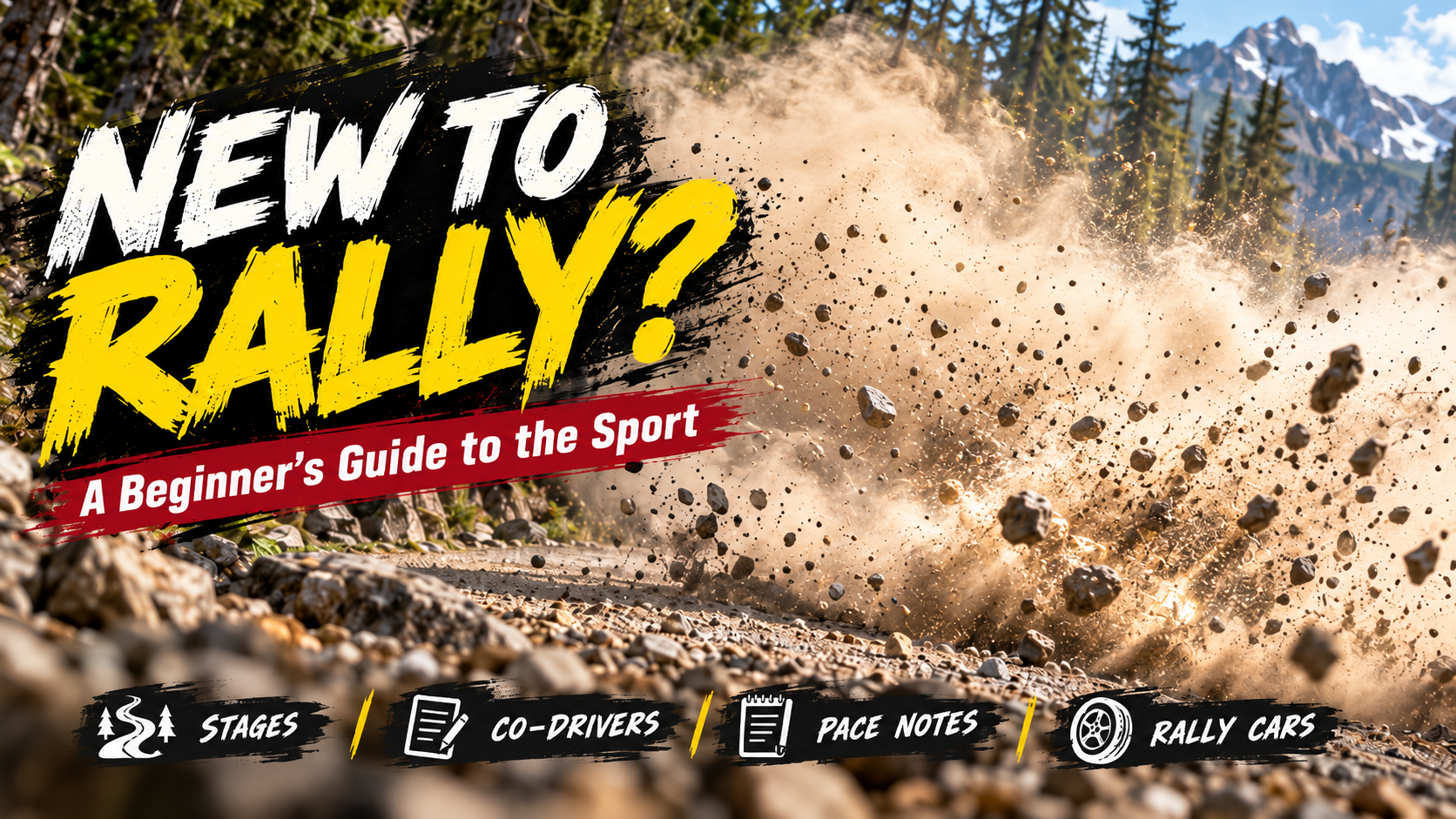
Rally racing is one of the most demanding forms of motorsport. Instead of racing wheel-to-wheel around a circuit, competitors tackle closed roads through forests, mountains, deserts, and sometimes snow-covered landscapes, racing against the clock rather than directly against one another.
The roads change, the weather is unpredictable, and there's rarely much room for error. One mistake can cost a few seconds, an entire stage, or the rally itself.
But how exactly does rally racing work? Why is there someone sitting in the passenger seat reading instructions? How are winners determined when the cars aren't even racing alongside each other?
If you're new to rally, this guide covers the fundamentals, from special stages and co-drivers to rally cars, championships, and how to experience an event yourself.
What Is Rally Racing?
Rally racing is a form of motorsport where drivers and co-drivers compete against the clock across a series of timed sections known as special stages.
Unlike traditional circuit racing, competitors don't generally start side by side. Instead, each crew starts a stage individually, usually at scheduled intervals, with the objective of completing it as quickly as possible.
These stages take place on roads closed to public traffic for competition. Depending on the event, they might include narrow gravel tracks, paved mountain passes, icy forest roads, or rocky terrain that would be difficult enough to navigate at normal speeds.
The crew with the lowest cumulative time across the rally's competitive stages, including any penalties, wins.
It sounds simple, but there's considerably more happening behind the scenes.
How Does a Rally Work?
A rally isn't one continuous race. It's an event made up of multiple stages, sometimes spread across several days and covering a large geographical area.
Each stage is its own timed competition, but all the results contribute to the overall standings.
Special Stages
Special stages, often abbreviated as SS, are where the actual racing takes place.
A crew starts at a designated point and races toward the finish as quickly as possible. Their time is recorded and added to their overall rally time.
Stage lengths vary considerably. Some are short spectator-friendly tests, while others stretch across lengthy sections of difficult terrain.
Throughout the event, drivers must balance speed with consistency. Winning one stage doesn't necessarily mean winning the rally.
A crew might set the fastest time on several stages, only to lose that advantage through a puncture, mechanical failure, or driving mistake.
Road Sections and Liaison Routes
Between competitive stages, crews travel along public roads to reach their next destination.
These are called road sections or liaison sections.
Here's the important distinction: liaison sections are not races.
Competitors must follow ordinary traffic laws, obey speed limits, and arrive at designated time controls according to the event schedule.
Depending on the event, arriving early or late at certain controls can result in time penalties.
That means rally involves more than driving quickly. Crews also have to manage their time and follow the event itinerary accurately.
Service Parks and Repairs
Rally cars take a beating, so teams need opportunities to inspect and repair them.
That's where the service park comes in.
During scheduled service periods, mechanics can work on the cars, change components, adjust suspension settings, and prepare the vehicles for the next stages.
However, service time is limited, and repairs outside designated areas are restricted by event regulations.
Sometimes a crew must deal with a mechanical issue themselves using tools and spare parts carried in the car. Other times, a problem means they cannot continue.
Between certain competition periods, cars may also be placed in parc fermé, a controlled area where working on the vehicles is generally prohibited.
Mechanical reliability is every bit as important as outright speed.
Drivers, Co-Drivers, and Pace Notes
One of the biggest differences between rally and many other forms of motorsport is the relationship between the driver and co-driver.
The driver controls the car, but the co-driver plays an essential role in getting it through the stages.
What Does a Co-Driver Actually Do?
During a competitive stage, the co-driver reads instructions known as pace notes.
These describe the road ahead, often including:
- The severity and direction of upcoming corners.
- Distances between corners and other features.
- Crests, jumps, dips, and changes in elevation.
- Hazards such as rocks, narrow bridges, and dangerous road edges.
- Places where the driver may need to slow down or adjust their racing line.
Pace notes allow drivers to anticipate what's coming before they can see it.
Without that information, maintaining competitive speeds on unfamiliar roads would be substantially more difficult.
Understanding Pace Notes
You might hear a co-driver call something resembling:
"Right 4, 100, left 2 tightens, caution crest."
The exact language varies between crews, but a simplified interpretation might be:
- Right 4: A right-hand corner with a particular severity rating.
- 100: Approximately 100 meters to the next instruction.
- Left 2 tightens: A tighter left-hand corner that becomes sharper.
- Caution crest: A rise in the road that requires additional attention.
Corner numbering systems aren't universal. Some crews use larger numbers for faster corners, while others use different conventions entirely.
The important part is that the driver and co-driver understand their system and trust one another.
Reconnaissance
Before many rallies, crews are allowed to study the stages through a process called reconnaissance, commonly shortened to recce.
During recce, they travel through the route under controlled conditions to prepare or refine their pace notes.
They aren't racing during this process.
A missed corner description or incorrect distance can have serious consequences once the stage is being driven at competition speed.
This is one reason co-driving requires considerable skill, preparation, concentration, and experience.
Rally Cars: What Makes Them Different?
At first glance, many rally cars resemble ordinary road-going vehicles.
Look closer, and the differences become obvious.
Modern competition cars are purpose-built or extensively modified to withstand repeated impacts, changing road conditions, and the physical demands of high-speed stage competition.
Depending on the regulations and category, a rally car may feature:
- Roll cage: A reinforced safety structure designed to protect the occupants during an accident.
- Competition suspension: Components designed to manage rough terrain, impacts, and changing grip.
- Underbody protection: Guards that help protect vulnerable mechanical components from rocks and debris.
- Competition seats and harnesses: Safety equipment designed to keep the occupants securely positioned.
- Specialized tires: Tires selected for the surface, weather, and conditions.
- Drivetrain and braking modifications: Components suited to the performance and durability demands of rally competition.
Not every rally car is an all-wheel-drive monster producing enormous horsepower.
In fact, many competitors race front-wheel-drive vehicles with relatively modest power.
A well-prepared car, driven consistently, can be far more effective than a powerful car that constantly breaks down.
Rally Car Classes
International rally competition uses several vehicle categories, with the FIA Rally Car Pyramid providing a framework for different levels of performance and accessibility.
The established categories include:
- Rally1: The top-tier category associated with the World Rally Championship.
- Rally2: High-performance four-wheel-drive competition cars commonly used by professional teams and experienced privateers.
- Rally3: Four-wheel-drive cars designed to provide a more accessible step into that type of machinery.
- Rally4: Performance-oriented two-wheel-drive rally cars.
- Rally5: An entry-level category intended to make competition more accessible.
Vehicle specifications and eligibility can change as regulations evolve.
National organizations also operate their own class systems. American rally competition, for example, uses categories that don't necessarily match the FIA pyramid directly.
The key thing to understand is that rally racing accommodates different budgets, vehicles, and levels of experience.
You don't need a factory-backed World Rally Championship car to participate in the sport.
Rally Surfaces and Why They Matter
One of rally's defining characteristics is the variety of environments competitors encounter.
A car that handles beautifully on dry pavement may require a completely different setup to perform effectively on loose gravel or snow.
Gravel
Gravel is one of the most recognizable rally surfaces.
Loose material reduces traction, while ruts, rocks, and changing road conditions demand careful car control.
Drivers often use controlled slides to position the car through corners, but there's a difference between spectacular driving and genuinely fast driving.
The quickest approach is whichever maintains the best speed and control through the stage.
Tarmac
Tarmac rallies take place on paved roads, often featuring narrow mountain passes, sharp corners, and rapid changes in elevation.
Traction can be relatively high in dry conditions, but wet pavement, mud dragged onto the road, and unpredictable grip make these stages challenging.
Precision is especially important when barriers, walls, or steep drops leave little room for mistakes.
Snow and Ice
Snow rallies introduce another challenge entirely.
Available grip can change dramatically depending on temperature, surface conditions, and tire regulations.
Some events permit specialized studded tires, while others restrict their use.
Momentum, smooth inputs, and the ability to read the road become particularly important.
The variety of surfaces is a major reason rally cars and drivers must be so adaptable.
Major Rally Championships Explained
There are rally championships throughout the world, ranging from grassroots regional competitions to international events attracting some of motorsport's most accomplished drivers.
Three organizations worth knowing are the WRC, ERC, and ARA.
World Rally Championship (WRC)
The FIA World Rally Championship represents the highest level of international stage rally competition.
Its events take place across different countries and environments, bringing together leading drivers, co-drivers, manufacturers, and private teams.
Historic events such as Rallye Monte-Carlo, Rally Finland, Rally Sweden, and Safari Rally Kenya demonstrate just how different rally competition can be from one location to another.
The WRC also features supporting categories that provide opportunities for competitors outside the premier class.
European Rally Championship (ERC)
The FIA European Rally Championship is one of rally's longest-established international competitions.
It features events across Europe and serves as both a competitive championship in its own right and an important development pathway for drivers pursuing international careers.
The ERC is particularly interesting because it brings together rising talent, established professionals, and teams competing with a variety of rally machinery.
American Rally Association (ARA)
The American Rally Association organizes and sanctions stage rally competition throughout the United States.
Its events feature professional teams alongside independent competitors, often using production-based vehicles modified for competition.
Rallies such as Sno*Drift, Rally in the 100 Acre Wood, and Lake Superior Performance Rally highlight the diversity of American stage rally.
For enthusiasts in the United States, these events provide opportunities to experience rally competition without traveling internationally.
And while the WRC attracts much of the worldwide attention, regional and national championships are essential to keeping the sport accessible and developing future competitors.
How Are Rally Winners Determined?
Rally standings are based primarily on cumulative time, not how many individual stages a crew wins.
At the end of each special stage, competitors receive a recorded time.
Those times are added together across the event. Applicable penalties are then factored into the overall classification.
A driver who wins several stages can still lose the rally if another crew performs more consistently.
For example, one mistake that costs 30 seconds can erase an advantage built over multiple stages.
Mechanical failures, punctures, incorrect time-control arrivals, and other incidents can also affect the standings.
Rally Results vs. Championship Points
It's important to distinguish between winning a rally and winning a championship.
An individual event is decided by its classification and applicable regulations.
A championship, however, awards points across multiple events throughout a season.
Points systems differ between championships and can change over time. Some competitions also award additional points for particular stages or classifications.
When following results, pay attention to both the event standings and the championship standings.
They tell two different stories.
How to Start Following Rally Racing
You don't need to understand every regulation, vehicle class, or pace-note call to start enjoying rally.
The easiest approach is to pick a championship or event and follow it from beginning to end.
As you watch, pay attention to how stage times change, which drivers are gaining or losing positions, and how road conditions affect their performance.
A few things are particularly useful for newcomers:
- Follow the overall standings rather than judging performance from individual highlights.
- Watch onboard footage to hear co-drivers reading pace notes.
- Compare how drivers approach different surfaces and corner types.
- Learn the difference between overall competitors and those racing within individual classes.
- Look at service reports and retirement updates to understand the mechanical side of competition.
You can use the Compromised Internals Rally Schedule to explore upcoming events and start following the championships that interest you.
If you're interested in how the sport developed, the Rally History Archive covers events, cars, and drivers from different eras of competition.
Experiencing Rally Racing in Person
Watching rally footage is one thing. Standing at a designated spectator area as a rally car approaches through a forest stage is something else entirely.
One of the most appealing parts of rally is that spectators can experience competition in environments completely different from traditional racing circuits.
Depending on the event, you may be able to watch cars launch through a corner, navigate a technical section, or pass through an organized spectator area.
However, rally spectating requires planning.
Stages can be geographically spread out, access roads may close well before competition begins, and parking may be limited.
Always use approved spectator locations and follow instructions from event organizers and marshals. Never enter a closed stage, stand in prohibited areas, or assume a location is safe simply because other spectators are standing there.
If you're planning to attend an event, start by reviewing the organizer's official spectator information.
Our Rally Travel section is also intended to help enthusiasts explore events and plan their trips.
Getting Involved Beyond Spectating
Rally isn't limited to professional drivers or people with enormous motorsport budgets.
There are several ways to become involved.
Volunteering is one of the most accessible starting points. Rally events rely on volunteers to help with stage operations, time controls, communications, spectator management, and other essential responsibilities.
You can also explore local motorsport clubs, learn about co-driving, attend rally schools, or research the licensing and safety requirements for competition.
The path into rally depends on your interests, experience, resources, and the regulations of the organization you intend to compete with.
But there's a place in the sport for considerably more people than those sitting behind the wheel.
Why Rally Racing Is Worth Following
Rally combines elements that few other forms of motorsport bring together in quite the same way.
There's the precision of the driver, the preparation of the co-driver, the engineering behind the car, and the challenge of adapting to roads and conditions that rarely stay consistent.
It's also a sport where reliability, judgment, and preparation can matter just as much as raw speed.
And while international championships showcase the highest levels of competition, grassroots events and regional organizations are just as important to rally's future.
Whether you're interested in the technology, the history, the competition, or simply experiencing an event for the first time, there's plenty to explore.
Rally racing is more than cars sliding through corners. It's a test of teamwork, consistency, preparation, and the ability to adapt when things don't go according to plan.
That's part of what makes it worth following.
For more information, explore our Rally Resources, browse the Event Calendar, or dive into the History Archive to discover the cars, drivers, and events that shaped the sport.